Skip to content
RoofPruf

Our differentiator

Solar-ready roofs in Slovenia, Italy and Austria

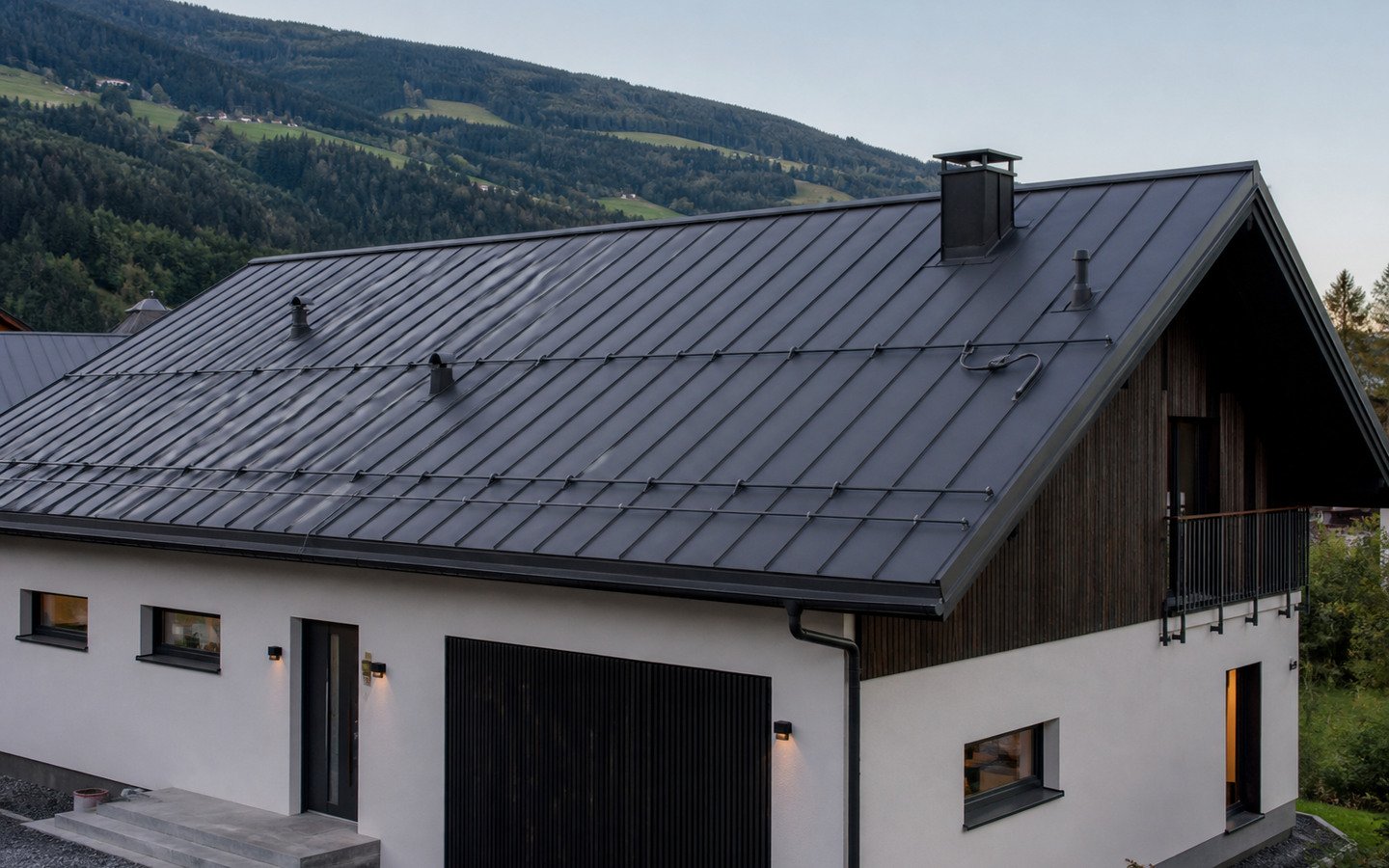
A solar-ready roof is a roof built with the photovoltaic interface already in it: a structural capacity check, a mounting grid set out and fixed while the roof is open, waterproofed and flashed penetrations, a cable route, fire and access provision, and a setting-out drawing with exact bracket coordinates. It contains no panels. Across Slovenia, Italy and Austria you can get a price for a roof and a price for a solar array. What almost nobody quotes is the layer between them: the structural check, the mounting grid set out before the battens go down, the waterproofed penetrations, the cable route, the fire detailing, and a written confirmation that installing PV later will not void the roof warranty. We made that a standard SKU with a fixed price.

Solar-ready roof — RoofPruf

What's included

Our range

€155–480 / m² for the whole roof

No public market rate exists for this scope in any of our three markets, which is why we publish our own instead of pointing at a guide. The figure above is the complete Solar-Ready Roof by market — €155–245/m² in Slovenia, €200–330 in Italy, €240–480 in Austria, excluding VAT — with the photovoltaic interface itself quoted as a fixed line item inside it. For contrast, the Austrian market prices bare PV mounting labour at around €1,080–1,800 for an eight-module array: that is fixing alone, and none of the structural, waterproofing or documentation work.

  • Structural capacity check for the additional PV dead load and the resulting wind uplift
  • Mounting bracket grid set out and installed with the covering, not drilled through it afterwards
  • System-supplier PV hooks or seam clamps matched to the covering — never a generic bracket
  • Every penetration waterproofed and flashed as part of the roof, under the roof warranty
  • Conduit and cable route from array position to the intended inverter location
  • Roof-space provision for DC isolation and firefighter access requirements
  • Setting-out drawing showing the exact bracket coordinates for the future installer
  • Written confirmation that the roof warranty survives a compliant PV installation
  • Handover pack any PV installer can build from without touching the waterproofing

Why retrofitting brackets is the expensive route

A PV installer arriving two years after the roofer has to lift tiles, find a rafter, fit a hook, and hope the covering seats back down correctly. Every one of those points is a future leak and an argument about whose warranty applies. Fitting the same brackets while the roof is open costs a fraction, leaks at a fraction of the rate, and leaves a single party responsible.

  • Brackets land on rafters located by measurement, not by tapping and guessing
  • Tiles are cut and dressed around brackets in the workshop conditions of an open roof
  • No lifted covering, no disturbed membrane, no re-bedded ridge two years later

Solar-ready is not the same as solar

We are deliberate about this because the market is not. Solar-ready is the roof-side interface: structure, fixings, waterproofing, routes and documentation. It does not include panels, inverter, DC/AC works, metering or grid application. A full residential array is a separate purchase — around €9,000–10,000 for a typical 4 kW system in Italy before incentives, on published figures. We quote the two separately so you can see what each actually costs.

The regulatory direction is one-way

The recast Energy Performance of Buildings Directive pushes new buildings toward solar readiness across the EU, with the general transposition deadline having passed on 29 May 2026. It does not oblige every existing house to fit PV. But if you are replacing a roof that will last 40 years, choosing not to prepare it is a decision you will be re-opening at your own cost.

Still have a question?

Discuss your roof with us — no sales script, no obligation.

See all questions

What is the difference between solar-ready and solar?

Solar-ready is the roof side of the interface: the structural capacity check, the mounting grid fitted while the roof is open, waterproofed penetrations, the cable route, fire and access provision, and a setting-out drawing. It contains no panels. Solar is the array itself — modules, inverter, DC and AC works, metering and grid application — which in Italy runs around €9,000–10,000 for a typical 4 kW residential system before incentives on published figures. We quote them separately, always, so you can see what each actually costs.

Will installing solar panels void my roof warranty?

With most roofers, fitting an array afterwards means someone lifting your covering and drilling through your waterproofing — and yes, that routinely ends the roof guarantee, or at least ends any useful argument about who caused a leak. On a RoofPruf Solar-Ready Roof, we install the brackets and flash the penetrations ourselves as part of the roof, and you get written confirmation that a compliant array on those fixings leaves the roof warranty intact. Where we install both roof and array, there is one warranty boundary and one party responsible.

Can my roof structure take solar panels?

Usually, but it has to be checked rather than assumed — and the panel weight is often not the governing case. Wind uplift on a raised array and the combination of array plus snow load frequently matter more. We run the load case against your actual rafter dimensions, spacing and span, together with the snow and wind actions at your location. Where the structure needs strengthening, we tell you before you buy panels rather than after.

Start with the survey. Decide after you have read it.

A fixed-fee survey, a written condition report with annotated photographs, a realistic remaining service life and a costed action list. Credited in full against your project if you go ahead — and still useful if you do not.

Water coming in right now? Mark the enquiry urgent or write to hello@roofpruf.com, and stay off the roof — do what is safe from inside while we read it.